
Mibu Kyogen is a folk theatre form in which a hereditary troupe (in this case, the Dai Nembutsu kyogen) act out wordless pantomime plays with masks and accompaniment on drums and a huge cymbal. Most of the plays have to do with fighting supernatural beings like oni (kind of like demons), nue (scary bird-monkey-monsters), and huge spiders or with kind of slapsticky, morally questionable everyday occurrences, like defeating thieves or two store owners who try to cheat each other.
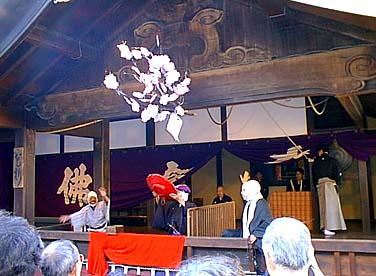
The stage is on a second story and then the audience are on the second floor of a second building next to the first so there's a gulf between us. You can see this below, plus the drums and cymbal in the back.

Also at Setsubun everyone was going to Mibudera, the temple where the kyogen takes place, and writing out their wishes on terracotta plates called Horaku. We also use horaku in tea as the tray for carrying ash when we do Dairo, the big hearth, in February. Anyway, what regular people do is write their wishes, then leave the horaku at the temple, because in April, the DaiNembutsu perform the play called Horakuwari (breaking horaku) which you see pictured above. This is the one where two businessmen, one a drum seller and one a horaku seller, try to cheat each other to get a government tax break (the first person to set up shop gets it) and one steals the other's merchandise while he's sleeping and then the first tries to get it back, etc. Eventually, when the horaku vendor wins the deal and sets up his shop with stacks and stacks and stacks of people's Setsubun horaku across the front of the stage (see the first photo), but the drum seller comes back (who was rightfully the first there at the beginning of the play) and knocks all the horaku off the stage to the ground two stories below. A huge cloud of dust rises up from the smashed plates and everybody's wishes should come true, but that's just incidental to the story.
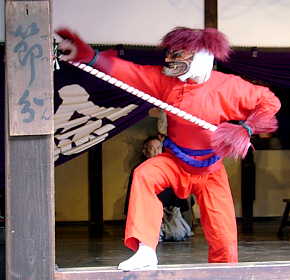
What I think is especially fascinating is that every character is masked (unlike Noh or classical kyogen) and even weirder, half the masks are really grotesque. Look at the two shop owners in the top photo. They are both regular humans, but the drum seller (who's knocking plates) is just as weird looking as the masks of the supernatural monsters, like this oni:
In the photo below you can see the clever/stupid servant at the left who will eventually save the day by first being indistinguishable from a cart in the dark, so that the thief will mistakenly tie his loot to the servant instead of his cart (his loot consists of kimonos-- this is not the only play I've seen in which treasure=kimono. Not surprising in the age before machine-made thread and fabric.)
Then the servant will take back the stolen items and fight the thief, who will get stuck in the tororo--sticky slippery taro-type potato. [Suffice it to say, when we used it for Christmas chakai, we called it "mucus potato."] Then he'll grate the thief's face with the tororo grater-- for anyone who's had to grate one of these potatos (during which process he or she almost definitely lost most of his or her knuckle skin in the process), this scene is shockingly violent nearly to the point of having to cover one's eyes. It's at least sufficient to make one clap one's hands to one's cheeks and squeal. Then the mistress of the house and her drunken guest (he's the one drinking from the cartoonishly huge red sake cup in the middle of the above scene) will wake up, run away, and also slip in the spilled potato.
So to recap. This is a regular person:


Not a big difference. Which I think is a very interesting commentary on what it means to be human and supernatural in Mibu Kyogen. That would be another book in itself.

No comments:
Post a Comment